
The creator finished the work, and the brand approved it. Then the invoice sits in an inbox for three weeks because the company name is wrong, the purchase order is missing, and “video package” does not show whether the invoice covers the signed scope or an extra edit.
This common creator-business problem creates avoidable payment delays. A brand deal invoice is a routing document as well as a request for money that has to survive a marketing manager, an agency producer, an accounts-payable system, and sometimes a procurement team that never saw the creative.
A complete invoice fixes the routing problem. The template below gives the buyer enough information to approve, match, and pay the invoice without reopening the entire campaign thread.
The eight lines every creator invoice needs
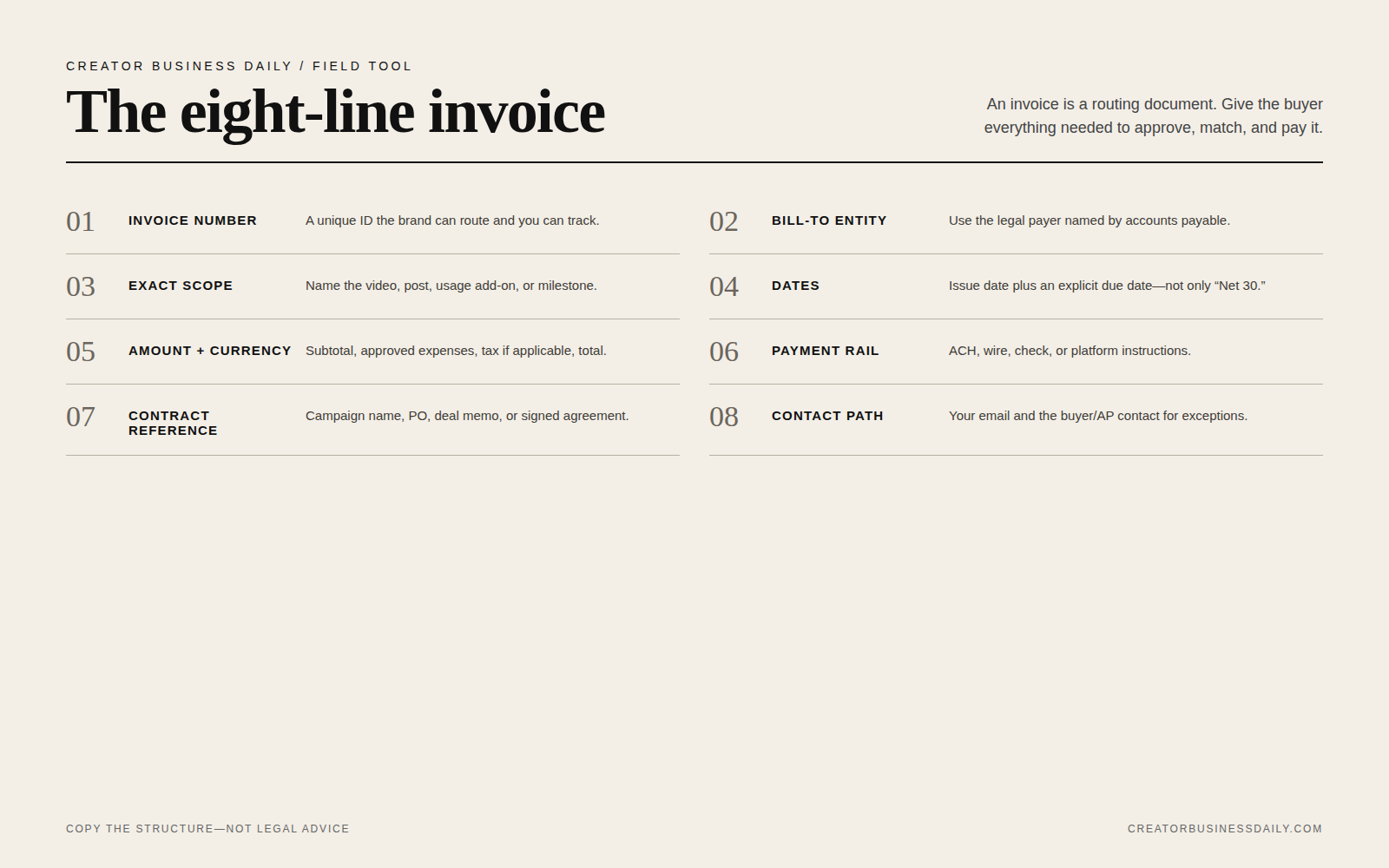
- A unique invoice number. Use a sequence you can search, such as CBD-2026-014 or MW-ACME-002. Never send three documents all named invoice-final.pdf.
- The legal bill-to entity. The brand people know may not be the company that pays. Ask whether the payer is the brand, its agency, a parent company, or a payment platform.
- The exact scope. Name the deliverable or milestone: one 30-second UGC video, three paid-social hooks, 90-day usage renewal, or campaign completion.
- The issue date and due date. Write both. “Due August 24, 2026” is harder to misread than “Net 30” alone.
- The amount and currency. Show the subtotal, approved expenses, tax if applicable, and final total. State USD, CAD, GBP, or the contracted currency.
- The payment rail. Provide the approved ACH, wire, check, PayPal, or platform instructions. Keep sensitive bank details in a secure document or payment portal when possible.
- The contract reference. Include the campaign name, purchase order, insertion order, deal memo, or signed-agreement date.
- The exception contact. Put your email on the invoice and record the marketing or accounts-payable contact who can resolve a mismatch.
Copy-and-paste brand deal invoice template
Use this as a starting structure. Adjust tax, business-name, and payment fields to your location and entity. This is operational guidance, not legal or tax advice.
INVOICE #[unique number]
From: [legal name or business name, mailing address, email]
Bill to: [legal payer name, address, AP email]
Campaign: [brand + campaign name + contract/PO reference]
Service: [specific deliverable, milestone, or usage renewal]
Issue date: [date] Due date: [date]
Amount: [subtotal + approved expenses + applicable tax = total, with currency]
Payment: [approved payment method and secure instructions]
Questions: [your email] / [buyer or AP contact]
The service line should match the commercial language in the agreement. If the contract says “three short-form videos plus 90 days of paid usage,” do not reduce that to “content services.” Specificity helps accounts payable match the invoice and helps you prove exactly what has—or has not—been paid.
Ask for the payment packet before you start
The fastest invoice is the one prepared before delivery. When the deal is signed, ask one operational question: “What does accounts payable need from me before it can release payment?”
The answer may include a vendor form, purchase-order number, tax form, bank verification, platform registration, or a required invoice email. Large brands often cannot pay until the creator exists in the vendor system. If onboarding starts after final approval, the creator has already donated time to the payment process.
For U.S. work, a payer may request Form W-9 so it has the creator’s correct taxpayer identification information for required reporting. The IRS describes Form W-9 as the form used to provide the correct taxpayer identification number to a person required to file an information return. Do not email sensitive tax or bank documents into a random campaign thread; use the brand’s secure route and verify the recipient.
An invoice cannot repair a vague contract
Creators sometimes try to solve a bad agreement with a detailed invoice. That is too late. The contract or written deal memo should establish the work, fee, payment date, revision boundaries, expenses, usage rights, cancellation terms, and the person with approval authority.
The invoice mirrors those terms; it does not invent them. If the contract says payment is due 30 days after final acceptance, the creator needs to know what counts as final acceptance and who gives it. If the agreement makes payment dependent on the brand’s client paying the agency, that is a different risk than a normal due date.
In New York City, the Freelance Isn’t Free Act provides a concrete example of why written terms matter. The city says covered contracts totaling $800 or more in a 120-day period must be written and spell out the work, pay, and payment date. It also says that when a covered contract omits a payment date, payment is due within 30 days after completion. Those rules are jurisdiction-specific, but the operating lesson travels: write the amount and the date before the work starts.
Separate production, licensing, and expenses
A clean invoice should let the brand see which part of the deal it bought. Do not hide every component inside one line if the agreement priced them separately.
- Production fee: concepting, scripting, filming, editing, and the agreed revision round.
- Usage license: channel, territory, and time window for paid or organic use.
- Whitelisting or creator licensing: the period during which the brand may run ads through the creator identity.
- Additional versions: hooks, cutdowns, raw footage, aspect-ratio exports, or language versions.
- Approved expenses: props, travel, talent, locations, shipping, or rush costs authorized in writing.
This structure matters after payment too. When a 90-day license expires, the creator can identify the original fee and quote the renewal without reconstructing the deal. Read CBD’s guide to UGC usage rights before bundling a license into a generic production line.
The five-day payment follow-up ladder
A professional follow-up sequence is factual. It does not accuse the brand on day one, and it does not wait silently for two months.
- On send: email the invoice to the required AP address, copy the buyer, and ask for confirmation that the packet is complete.
- Five business days before due: confirm the invoice is approved and ask whether any vendor or PO field is missing.
- On the due date: send the invoice number, total, due date, and payment method in one short note.
- Three to five business days late: ask for the scheduled payment date and the person responsible for the exception.
- After the contractual cure period: follow the agreement and applicable local process. Preserve the contract, approvals, delivery evidence, invoice, and correspondence.
Do not make the follow-up a new creative pitch. The goal is to get one operational answer: approved, missing information, scheduled, or disputed. Every response should move the invoice into one of those states.
The final invoice QA
Before sending, run this 60-second check:
- Does the bill-to name match the payer’s legal entity?
- Does the scope match the signed agreement and approval email?
- Are the issue date, explicit due date, amount, and currency visible?
- Is the invoice number unique?
- Are the payment instructions secure and correct?
- Are the PO, campaign, and buyer contacts included?
- Did you save a PDF and the email confirmation in the same deal folder?
Then update a simple deal tracker. Record invoice number, send date, due date, amount, status, payment date, usage expiration, and the next action. A simple tracker gives the creator one source of truth and a habit of checking it.
The invoice is part of the product
Brands remember creators who make the whole campaign easier. That includes files, revisions, usage terms, approvals, and payment operations. A clear invoice signals that the creator understands content and the business systems around it.
It also protects the relationship. Instead of sending a tense “just checking in,” the creator can point to an invoice number, a contractual date, and a missing field. The conversation becomes an operational fix.
If your rates and usage terms are still fuzzy, start with How to Price a UGC Video Without Guessing. If you are ready for brand review, submit your profile through the Brand Deals page.
Sources and scope
- Internal Revenue Service, About Form W-9, reviewed/updated June 27, 2026; verified July 25, 2026.
- New York City Department of Consumer and Worker Protection, Freelance Worker Rights; verified July 25, 2026.
Rules differ by country, state, city, worker classification, and contract. Creators should use qualified tax or legal help for their situation.