
U.S. creator ad spend is growing fast, but brands still struggle to choose creators, track results, and manage the work after a campaign starts.
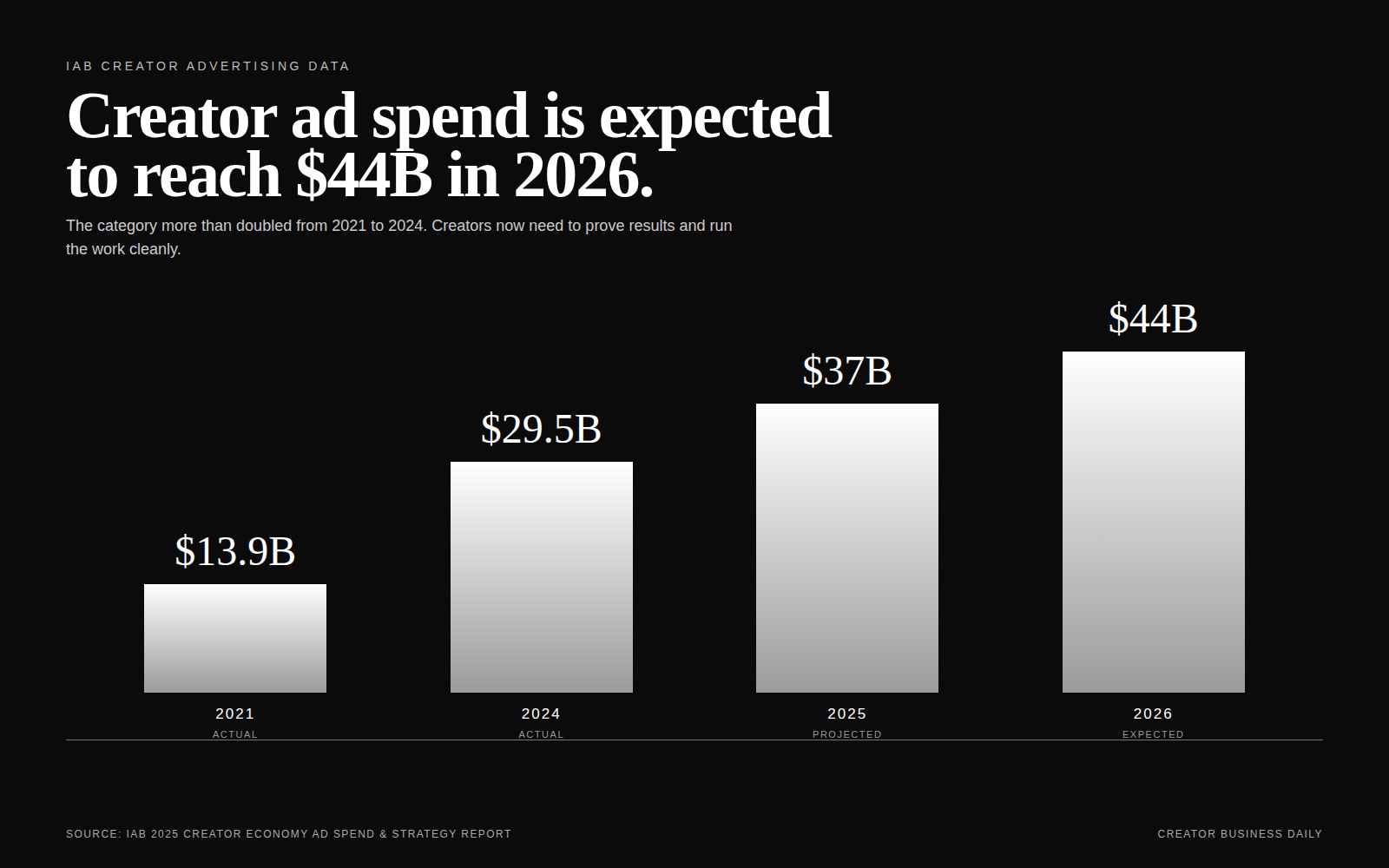
IAB projects U.S. creator advertising spend will reach $44 billion in 2026. Its latest report says the category grew from $13.9 billion in 2021 to $29.5 billion in 2024, was projected at $37 billion in 2025, and is now expanding far faster than the broader media market.
More spending will not automatically raise every creator’s income. Brands still struggle to identify the right creators, measure business outcomes, manage rights, and repeat what works.
Creators who make results easy to verify will be easier to hire, renew, and scale.
The category crossed the credibility line
Nearly half of creator ad buyers, 48%, now describe creators as a “must buy,” according to IAB. That puts creator advertising just behind paid search and social media in the buyer hierarchy.
Brands now fund creator work across awareness, reach, and sales. A single creator asset may run in organic social, paid ads, retail pages, landing pages, email, and performance campaigns.
When budgets were small, the market could tolerate fuzzy scope and anecdotal reporting. At $44 billion, those weaknesses become procurement and measurement problems. More investment brings more demands: standardized briefs, clean contracts, secure files, defined licenses, usable performance data, and evidence that a creator was selected for a reason.
What the $44 billion forecast means for creators
The forecast can concentrate spending in platforms, agencies, management companies, celebrity talent, technology vendors, and creators who already have proven distribution.
Small and mid-sized creators should resist the comforting interpretation that rising spend automatically lifts all rates. It lifts the value of creators who solve a costly brand problem. That may be trusted audience access, credible category expertise, a repeatable conversion format, fast UGC production, or a clean testing system.
The rate question therefore changes from “How many followers do you have?” to “What can a buyer predict after hiring you?” A creator with a smaller audience but a clear category, documented process, and testable creative can be easier to buy than a larger creator with vague positioning.
Make category fit easy to judge
IAB says brands cite identifying the right creators as their top challenge. Platforms can improve matching, but creators still need to package their work so buyers can judge fit quickly.
Many creators make buyers infer too much. Their bio does not name a category. Their portfolio shows videos without explaining the job of each asset. Their rate card mixes production and usage. Their case study celebrates views without showing the campaign objective. The brand cannot judge fit because the profile leaves the category and the job of each asset unclear.
Build a profile a buyer can judge quickly. CBD’s 45-second UGC portfolio guide gives the practical structure: clear lane, labeled formats, proof layer, rates or scope logic, usage note, and one contact path.
Label each level of proof
Creators often think proof means a perfect attribution report. Brands often know the data is messier. A useful system starts with the strongest evidence available and labels it honestly.
- Delivery proof: the creator delivered the agreed formats, deadlines, and revisions.
- Creative proof: hook variants, retention points, saves, comments, watch time, or buyer feedback show why the asset worked.
- Distribution proof: reach, qualified audience composition, traffic, profile visits, or platform-native engagement.
- Commercial proof: tracked clicks, leads, sales, assisted conversions, cost per acquisition, or a brand-confirmed lift.
- Renewal proof: the brand extended usage, commissioned more assets, raised scope, or brought the creator back.
Only claim sales you can attribute, and preserve weaker signals with honest labels. A high save rate and a usage renewal are weaker signals than attributed revenue, but both can still reduce buyer uncertainty.
Measurement changes the deliverable
If a campaign will be judged on sales, the creator needs that information before scripting. The brief should define the audience, offer, destination, tracking method, organic or paid distribution, testing window, and what the brand is allowed to change.
Measurement affects deal terms. A brand cannot reasonably demand performance accountability while withholding the landing page, offer, paid-media plan, or results. A creator cannot promise a business outcome while controlling only one video.
Assign responsibility in writing. The creator owns the agreed creative inputs. The brand owns the parts it controls: product, pricing, page, media spend, targeting, checkout, inventory, and attribution. The post-campaign review looks at the whole system rather than blaming the visible person in the ad.
Operational records make creators easier to rehire
IAB identifies measurement, standards, and operational tools as the largest improvement opportunities. For creators, that means:
- A profile that makes category and format fit obvious.
- A brief review that turns vague goals into testable deliverables.
- A rate card that separates production, usage, and creator licensing.
- A contract and invoice that name the payer, dates, scope, and approval path.
- A file system that preserves versions, approvals, links, and usage expirations.
- A case study that distinguishes fact, inference, and brand-supplied data.
These records give creative skill a commercial structure. When two creators can both make a strong video, the creator who reduces coordination risk is easier to hire again.
AI will make selection harder before it makes it easier
Three in four brands are using or planning to use AI for creator-marketing tasks, IAB reports. Matching and workflow tools will expand the top of the funnel. The same tools will also produce more synthetic sameness: more lists, more outreach, more generated briefs, and more creators who look similar in a database.
Creators should invest in proof they own: real audience relationships, documented category insight, original data, recurring formats, verified performance patterns, and clean campaign records.
A portfolio summary is less valuable than the history behind a renewal, a credible community, a founder who trusts the creator, or a body of work that consistently makes a complicated product understandable.
A case study should answer six questions
As creator budgets mature, a case study should read less like a celebration and more like an operating record:
- What did the brand need to change?
- Why was this creator a fit?
- What did the creator make, and under what constraints?
- Where did the asset run, for how long, and with what rights?
- What happened, with the source and limitations of every metric?
- What did the brand or creator do next?
The final question is underrated. Renewal, expanded usage, or a second brief is evidence that the work created enough value to buy again. Creators should track those outcomes alongside reach.
What creators should do this week
- Choose one commercial lane. Name the category, buyer, format, and problem you solve.
- Turn three examples into mini case studies. State the objective, creative choice, evidence, and limitation.
- Ask for measurement before agreeing to performance language. Do not promise access to data the brand will not share.
- Separate the rights. Organic posting, paid usage, whitelisting, raw footage, and exclusivity are not one line item.
- Build the renewal reminder. Record when each license expires and contact the buyer before it silently continues.
If you need the deal-structure layer, read How to Read a Brand Brief Without Getting Boxed In when it publishes, and use CBD’s existing guides to UGC pricing and usage rights now.
Make proof easy to verify
Larger creator budgets bring stricter requirements. Creators who make fit, scope, proof, rights, and the next test easy to verify will be easier to hire again.
Creators with a clear category, current examples, and deal preferences can submit through CBD’s Brand Deals page.
Source and methodology
- IAB , 2025 Creator Economy Ad Spend & Strategy Report, including the linked full report; verified July 25, 2026.
The 2025 and 2026 figures are IAB projections/expectations, not audited final totals. Creator Business Daily’s operating conclusions are analysis based on the report’s published market size, buyer-priority, selection, AI, measurement, and workflow findings.