

A UGC deal tracker gives every promise a field, an owner, and a date. It should show the exact scope, rights window, approval state, invoice deadline, and next action for every campaign.
Build the row when the buyer sends a real brief. Waiting until delivery leaves the agreement scattered across DMs, email, a contract, and an invoice.
the 24 fields to track
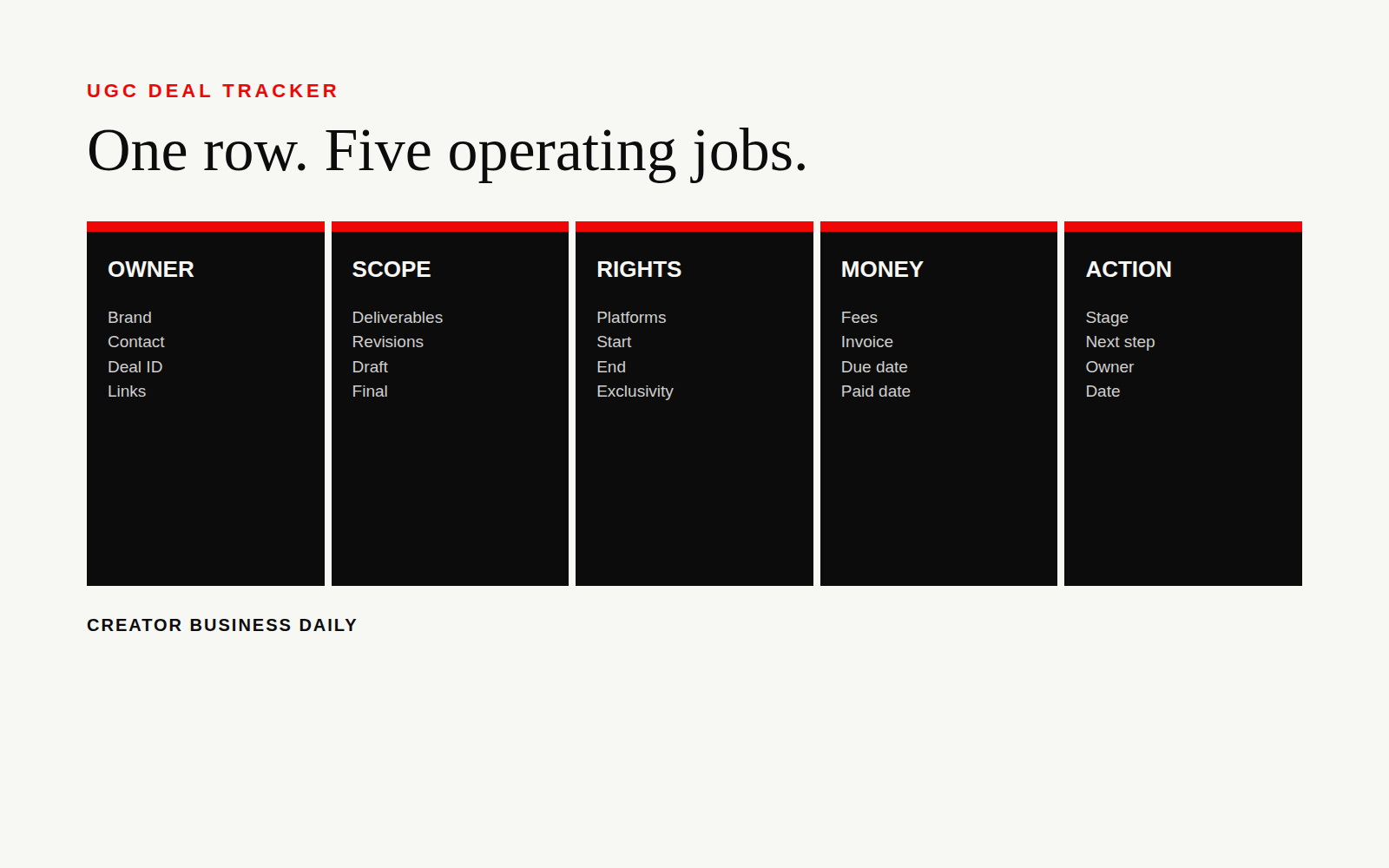
Use one row per campaign and group the columns by job.
identity and ownership
- Deal ID, brand, agency, campaign, creator, primary contact, and internal owner.
- Contract link, brief link, asset folder, and signed date.
scope and delivery
- Deliverables, formats, concept count, included revisions, draft due date, approval due date, and final delivery date.
rights and restrictions
- Organic posting, paid usage platforms, usage start, usage end, partnership ad access, territory, exclusivity category, and exclusivity end.
money and collection
- Creative fee, rights fee, expenses, total contracted amount, invoice number, invoice sent date, payment due date, payment status, paid date, and follow-up date.
current action
- Deal stage, next action, action owner, next-action date, open question, and risk flag.
copy the starter row
deal_id,brand,agency,campaign,contact,stage,next_action,next_action_date,deliverables,revisions_included,draft_due,final_due,creative_fee,rights_fee,total,paid_usage_platforms,usage_start,usage_end,partnership_ad_access,exclusivity_category,exclusivity_end,invoice_number,invoice_sent,payment_due,payment_status,paid_date,contract_link,brief_link,asset_folder,risk_flag
Use controlled values for the fields that drive reporting. Deal stage can be inquiry, quoting, contracting, production, review, delivered, invoiced, paid, renewed, or closed. Payment status can be unsent, sent, due, late, disputed, or paid.
Free-text notes still have a place, but dates and status labels should remain sortable. A weekly review fails when every row says “waiting” with no owner or deadline.
why the contract fields matter
Freelance payment rules differ by location. New York City's Freelance Isn't Free Act requires a written contract when covered agreements reach $800 in a 120-day period. The contract must describe the work, the pay, and the payment date. When the contract lacks a payment date, the city says covered workers must be paid within 30 days after completing the work.
California's Freelance Worker Protection Act covers qualifying professional-services contracts at $250 or more, including qualifying amounts aggregated over the prior 120 days. The written contract must include an itemized list of services, their value, the rate and method of compensation, the payment date or method for determining it, and the deadline for submitting a list of services for internal payment processing. The act applies to contracts entered into or renewed on or after January 1, 2025.
These rules do not apply to every creator or deal. They show why scope, payment dates, and documentation belong in the tracker. Check the law that applies to the hiring party and creator, and use a lawyer for legal advice.
connect every deadline
The draft date affects the review date. The review date affects final delivery. Final delivery may trigger the invoice. The invoice date determines the payment follow-up. Put those dates beside one another so a delay in one stage produces a visible change in the next.
Do the same for rights. Record the first day an ad may run, the final approved day, and the renewal follow-up date. A contract folder holds the agreement. The tracker tells the creator when to act on it.

keep revisions and rights separate
A revision changes the asset. A rights extension changes how long or where the asset may be used. Track them in separate columns and quote them as separate line items.
When a buyer asks for “one more change,” update the revision count and approval date. When the buyer asks to keep the ad live, update the rights end date only after the extension is approved and priced.
run a 15-minute weekly review
- Filter for next actions due within seven days.
- Filter for drafts or approvals past due.
- Filter for invoices due or late.
- Filter for rights or exclusivity ending within 30 days.
- Assign one owner and one date to every open item.
Close stale inquiries. Archive completed rows after payment and rights expiry. Keep contracts, approvals, invoices, delivery receipts, and live-ad screenshots linked from the row.
sources
- New York City Department of Consumer and Worker Protection, Freelance Worker Rights
- California Legislature, SB 988 Freelance Worker Protection Act
Pair the tracker with CBD's brand deal invoice template and usage-rights checklist.
build the first row
Copy the header, enter the active campaigns, and give every open item a date.
Submit your creator profileCreator Business Daily covers the business side of being a creator: earnings, deals, tools, and what's working now.